Mental Well-being: What are we Missing?
Rethinking the relationship between mental wellness, health, illness, fitness and functioning.
Conversations surrounding mental health have become increasingly common. We hear discussions about raising awareness, reducing stigma, improving access to care, and supporting those experiencing mental illness. These conversations are important and long overdue. Yet, despite the growing focus on mental health, there remains considerable confusion around the language we use.
Terms such as mental well-being, mental wellness, mental health, mental illness, and mental fitness are frequently used interchangeably, as though they describe the same concept. More often than not, discussions about mental health quickly become discussions about mental illness. While mental illness forms an important part of the conversation, it is only one component of a much broader picture.
This raises a more important question: What are we missing?
When our understanding centres primarily on diagnosis and treatment, we risk overlooking other equally important aspects of supporting people throughout their lives. We spend far less time discussing how to promote mental well-being before difficulties arise. How to build the psychological and life skills that help us navigate everyday life, how our ability to function changes over time, or how our environments, relationships, purpose, and lifestyle shape our mental well-being.
Concerningly, we often blend concepts that serve fundamentally different purposes. Promotion is not prevention. Prevention differs from early intervention. Early intervention is not treatment, and recovery is not rehabilitation. Mental fitness is not the same as recovering from burnout, nor is treatment synonymous with well-being. Each concept has a vital role; yet when these concepts become blurred, our understanding of mental well-being remains incomplete.
Within the Supportive and Integrative Wellness (SIW) © framework, mental well-being is viewed as a dynamic, interconnected system rather than a single concept. It is influenced by multiple interacting factors and supported through different approaches, depending on an individual's needs. Rather than replacing existing psychological or medical models, this framework aims to broaden the conversation by recognising that promoting lifelong well-being involves far more than addressing illness alone.
Mental Well-being: The Umbrella
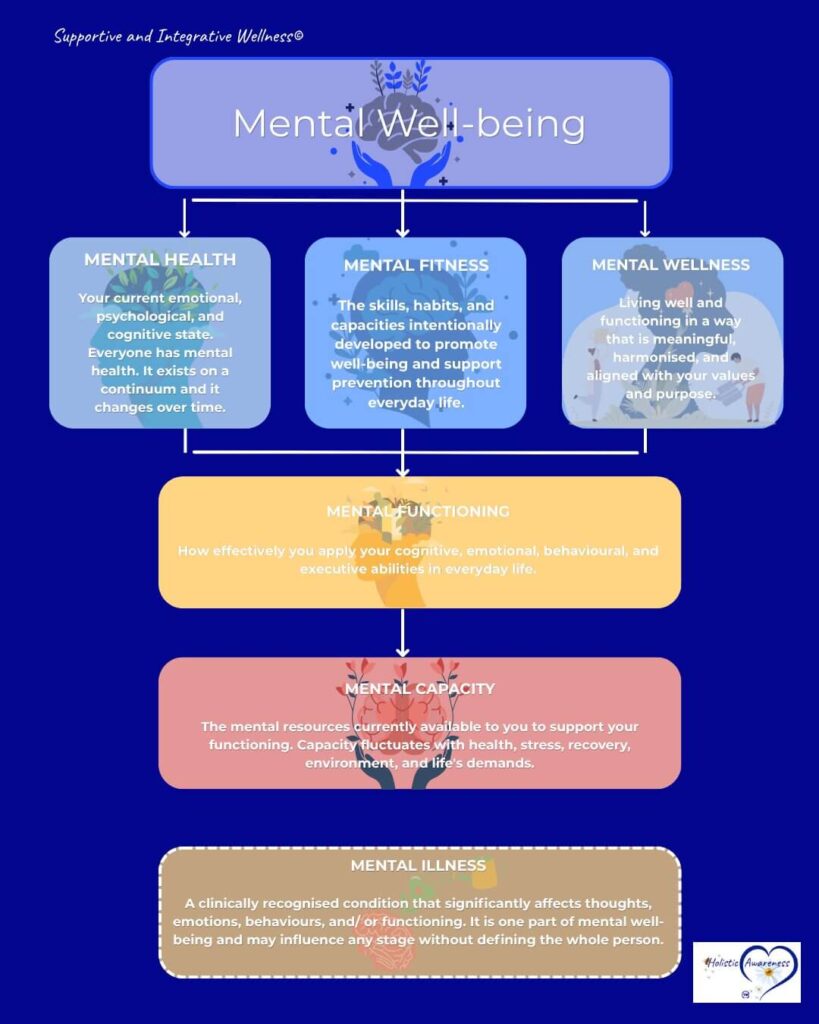
Within the SIW framework, mental well-being is conceptualised as the overarching umbrella under which several related yet distinct concepts fall. It reflects the interaction between our emotional, psychological, cognitive, social, behavioural, and functional experiences throughout life. Rather than representing a fixed state, mental well-being changes as we respond to developmental stages, life experiences, challenges, relationships, environments, and growth opportunities.
Understanding mental well-being as an umbrella allows us to distinguish between concepts that are often confused. These include mental wellness, mental health, mental illness, mental fitness, and mental functioning. Each contributes differently to overall well-being, each answers a different question, and each requires different forms of support.
Mental well-being is also influenced by factors that extend beyond the individual. Physical health, sleep, nutrition, movement, relationships, work, education, financial security, culture, community, purpose, values, and access to appropriate support all influence how people experience and maintain well-being over time. Recognising these influences encourages a holistic understanding of well-being rather than reducing it to symptoms or diagnoses alone.
Mental Wellness: Living Well
Mental wellness, as defined by the SIW methodology, refers to the holistic experience of living a healthy, functional, and meaningful life. While mental well-being provides the broader framework, mental wellness reflects how that framework is experienced in everyday living.
Mental wellness extends beyond emotional happiness or the absence of distress. It considers the whole person, recognising that well-being emerges through the interaction of emotional, cognitive, psychological, social, physical, and purposeful aspects of life. It is reflected in how we engage with our relationships, participate in meaningful activities, care for ourselves, adapt to challenges, and align our daily lives with our values and goals.
Importantly, mental wellness does not imply that life is free from adversity. Individuals may experience stress, grief, disappointment, or even live with a diagnosed mental illness while still demonstrating many aspects of wellness through supportive relationships, meaningful participation, healthy routines, and a sense of purpose. Conversely, someone may appear comfortable on the surface while experiencing a lack of direction, connection, or fulfilment that diminishes their overall wellness.
Mental wellness, therefore, asks a broader question: Am I living in a way that supports a healthy, functional, and meaningful life?
Mental Health: Our Current State
Mental health is perhaps the most misunderstood concept in discussions of mental well-being. It is frequently used as though it refers exclusively to mental illness, yet this interpretation overlooks an important reality: Everyone has mental health, regardless of whether they have a diagnosis.
Mental health is an individual's current emotional, psychological, and cognitive state. It shows how we think, feel, cope, adapt, make decisions, regulate emotions, relate to others, and respond to the demands of everyday life.
Mental health is a continuum. It naturally fluctuates as our internal experiences and external circumstances change. Factors such as sleep, physical health, relationships, work demands, grief, financial pressures, major life transitions, and social support can all influence where we find ourselves along this continuum.
Understanding mental health as a dynamic state helps us move beyond simplistic, healthy-versus-unhealthy thinking. A person living with a diagnosed mental illness may experience positive mental health through effective treatment, supportive relationships, and meaningful engagement in life. Likewise, someone without any diagnosis may experience poor mental health during periods of prolonged stress, burnout, or significant life change.
Mental health, therefore, asks: How am I doing mentally right now?
Mental Illness: When Clinical Intervention is Necessary
Mental illness refers to clinically recognised conditions that significantly affect an individual's thoughts, emotions, behaviours, and functioning beyond what would generally be expected as part of everyday human experience. These conditions are characterised by patterns of symptoms that may require professional assessment, diagnosis, intervention, and treatment.
Within the SIW framework, mental illness represents one component of mental well-being rather than the whole of it. While a diagnosis provides valuable clinical information, it does not define an individual's identity, capabilities, strengths, relationships, or potential to live a meaningful life.
Recognising this distinction is important because mental illness and mental health are not synonymous. Someone may live with depression, anxiety, bipolar disorder, or another diagnosed condition while maintaining positive mental health in many aspects of their life through appropriate support and self-management. Equally, individuals without a diagnosis may still experience poor mental health that deserves recognition and support.
Mental illness, therefore, asks: Is there a clinically significant condition requiring assessment, intervention, or treatment?
Mental Fitness: Building Well-being Before Problems Arise
Mental fitness represents the proactive dimension of mental well-being. Just as physical fitness involves developing strength, endurance, and flexibility to support long-term physical health, mental fitness involves intentionally developing the psychological capacities that help individuals navigate everyday life.
In SIW, mental fitness is centred on creation, promotion and prevention rather than treatment. Its purpose is to build and maintain the skills, habits, and capacities that contribute to lifelong well-being before significant difficulties arise.
Mental fitness includes developing emotional regulation, self-awareness, psychological flexibility, resilience, healthy coping strategies, reflective practice, communication skills, problem-solving, healthy boundaries, supportive relationships, and restorative habits. These capacities strengthen our ability to adapt to challenges while supporting long-term mental well-being.
Unlike treatment, recovery, or rehabilitation, mental fitness is not designed to address illness after it occurs. Instead, it focuses on strengthening the foundations that help individuals remain well and adapt more effectively when challenges inevitably arise.
Mental fitness, therefore, asks: What skills, habits, and capacities am I building to support lifelong mental well-being?
Mental Functioning and Mental Capacity
Mental functioning refers to how effectively an individual uses their cognitive, emotional, behavioural, and executive capacities in everyday life. While mental health reflects our overall psychological state, mental functioning considers how that state influences what we can do. Mental functioning includes abilities such as planning, organisation, attention, working memory, decision-making, emotional regulation, behavioural regulation, problem-solving, self-monitoring, cognitive flexibility, and task completion. These skills influence our participation at work, in education, within relationships, and throughout everyday life. Closely related is mental capacity, which refers to the internal resources available to support functioning at any given time.
Capacity may fluctuate in response to sleep quality, stress, illness, physical health, emotional demands, workload, or environmental pressures. A person may possess strong underlying abilities while temporarily lacking the capacity to perform at their usual level because their mental resources have been depleted.
Recognising the relationship between functioning and capacity helps explain why individuals may struggle during periods of prolonged demand without necessarily experiencing mental illness. It also highlights the importance of recognising early changes before they progress into more significant difficulties.
Mental functioning, therefore, asks: How effectively am I functioning, and what mental capacity do I currently have available?
Supporting Mental Well-being Across the Continuum
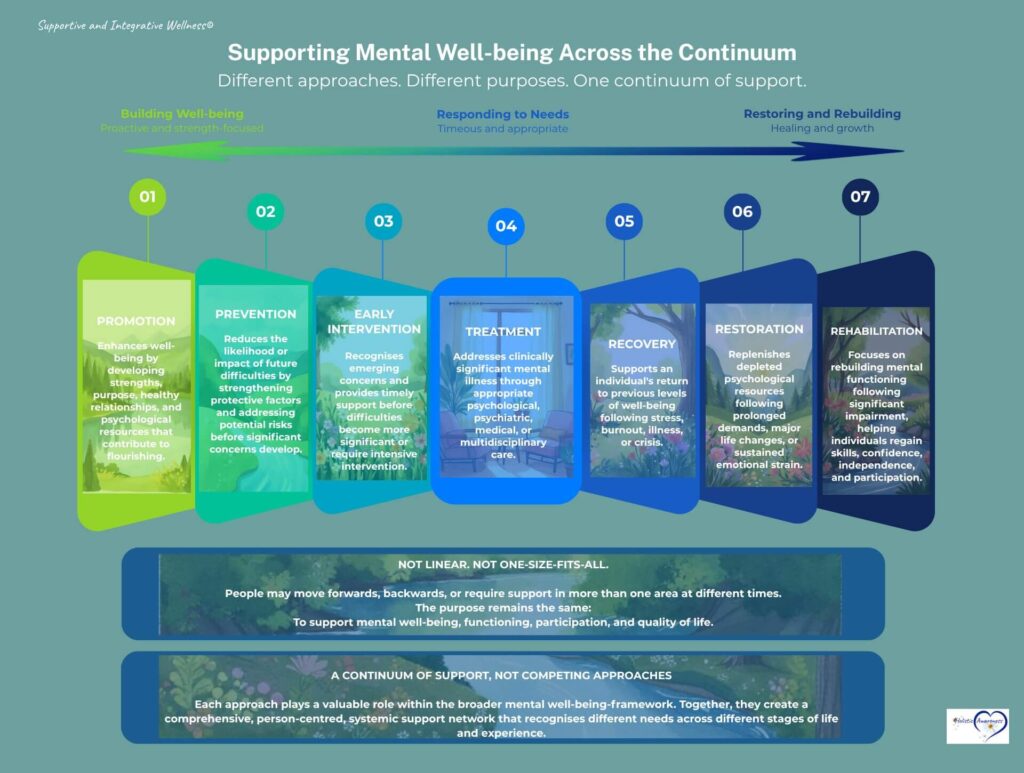
Once we distinguish the different components of mental well-being, it becomes easier to understand that different approaches serve different purposes. Promotion focuses on enhancing well-being by developing strengths, purpose, healthy relationships, and psychological resources that contribute to flourishing. Prevention seeks to reduce the likelihood or impact of future difficulties by strengthening protective factors and addressing potential risks before significant concerns develop.
In contrast, early intervention recognises emerging concerns and provides timely support before difficulties become more entrenched or require intensive treatment. Treatment focuses on addressing clinically significant mental illness through appropriate psychological, psychiatric, medical, or multidisciplinary care.
Recovery refers to returning to previous levels of well-being following stress, burnout, illness, or crisis, and restoration involves replenishing depleted psychological resources following prolonged demands, major life changes, or sustained emotional strain. Lastly, rehabilitation focuses on rebuilding mental functioning after significant impairment, helping individuals regain skills, confidence, independence, and participation.
These concepts should not be viewed as competing approaches. Rather, they form a continuum of support, each contributing differently to overall mental well-being depending on the individual's needs and circumstances.
Understanding the Difference
| Concept | Primary Question | Primary Focus |
| Mental Well-being | How is my overall well-being supported? | The interaction of all dimensions influencing psychological well-being. |
| Mental Wellness | Am I living a healthy, functional, and meaningful life? | Holistic quality of life and flourishing. |
| Mental Health | How am I doing right now? | Current emotional, cognitive, and psychological state. |
| Mental Illness | Is there a clinically significant condition? | Assessment, diagnosis, intervention, and treatment. |
| Mental Fitness | Which skills and capacities am I building? | Promotion, prevention, resilience, and psychological skills. |
| Mental Functioning | How effectively am I functioning? | Everyday executive, cognitive, emotional, and behavioural performance. |
| Mental Capacity | Which resources do I currently have available? | The internal reserves that support functioning and adaptation. |
How These Concepts Work Together
Rather than existing independently, each component of mental well-being influences the others. Developing mental fitness strengthens our ability to function effectively. Strong mental functioning supports positive mental health, which contributes to broader mental wellness and overall mental well-being.
Likewise, changes in one area can influence others. A diagnosed mental illness may affect mental health, reduce functioning, or temporarily diminish capacity, yet it does not remove an individual's strengths, relationships, values, purpose, or opportunities to experience well-being. Similarly, someone without a diagnosed mental illness may experience reduced mental health because of grief, trauma, prolonged stress, burnout, financial hardship, or significant life transitions.
Recognising these interactions encourages a more balanced understanding of mental well-being; one that acknowledges the importance of diagnosis and treatment while giving equal attention to prevention, promotion, functioning, and the development of lifelong psychological resources.
Expanding the Conversation
Perhaps what has been missing from our conversations about mental well-being is not greater awareness of mental illness, but a broader understanding of everything that exists alongside it. When we reduce mental well-being to diagnosis alone, we overlook opportunities to promote wellness, strengthen mental fitness, support functioning, recognise changes in capacity, and intervene early before significant difficulties arise. We also risk defining people by their diagnoses rather than recognising the many factors that contribute to a healthy, meaningful, and purposeful life.
Within the SIW framework, mental well-being is understood as far more than the absence of illness. It is cultivated through promotion, protected through prevention, strengthened through mental fitness, supported through healthy functioning, enhanced by meaningful relationships and purposeful living, restored following life's demands, rehabilitated when function has been significantly affected, and treated appropriately when mental illness is present.
By recognising these distinct yet interconnected concepts, we move beyond asking whether someone has a mental illness and begin asking a far more important question: How can we best support lifelong mental well-being?